Oral Health & Child Development
Why You Should Track Your Child’s Tooth Eruption
The reassuring truth Children do not all get their teeth on the same schedule. Eruption charts show typical ranges, not deadlines. What matters most is the overall pattern, your child’s growth, and whether teeth are appearing in a healthy sequence.
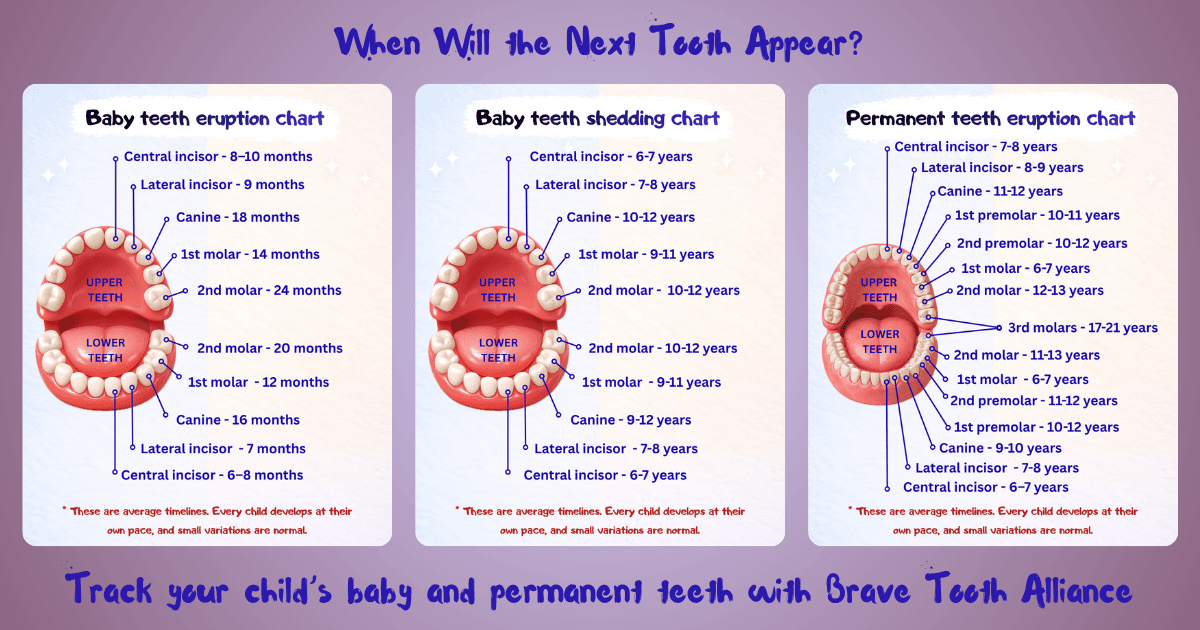
Every child’s tooth timeline is different
One child may lose a front tooth in kindergarten while a classmate keeps every baby tooth for another year. A younger sibling may seem to get teeth much earlier than an older one did. These differences often make parents wonder whether their child’s tooth eruption is normal.
Most timing differences are completely normal. Tooth eruption varies just like height, speech, and coordination. A tooth eruption chart can help you understand the usual order and broad age ranges, but it should never become a deadline or a reason to compare your child with others.
Tracking does not mean checking anxiously every day. It means noticing the general pattern during normal brushing, keeping regular dental appointments, and asking questions when something looks painful, very uneven, or significantly different from the expected sequence.
What does tooth eruption mean?
Tooth eruption is the gradual movement of a developing tooth through the jaw and gums until it becomes visible in the mouth. Children pass through two main stages:
- Primary, or baby, teeth appear first and form a complete set of 20 teeth.
- Permanent teeth begin replacing baby teeth during the early school years, while permanent molars erupt behind the baby teeth.
The years when baby and permanent teeth are present together are called the mixed-dentition stage. During this time, the teeth, jaws, and bite are changing quickly.
Why tracking tooth eruption matters
1. It can reveal a missing or blocked permanent tooth
Permanent teeth develop inside the jaw before they erupt. By following which baby teeth are lost and which permanent teeth appear, a dentist can notice when a tooth may be absent, delayed, or following an unusual path. When clinically appropriate, an X-ray can show whether the permanent tooth is present and whether space or another tooth is blocking it.
Early discovery does not always mean immediate treatment. Often, it simply allows the dentist to monitor development and plan the least complicated approach.
2. It helps check whether eruption is reasonably symmetrical
Matching teeth on the right and left sides often appear within a broadly similar period. Perfect symmetry is not required, and one side may be ahead. A large or persistent difference, however, can be worth checking—especially when a baby tooth was lost long ago and the matching permanent tooth has already appeared on the other side.
3. It supports bite and jaw development
Baby teeth do more than help children chew and speak. They help hold space and guide permanent teeth. Monitoring the transition allows the dental team to follow crowding, crossbites, jaw relationships, and other changes in the developing bite. Not every irregularity needs treatment, but timely observation helps distinguish normal growth from changes that may need support.
4. It helps protect baby teeth while permanent teeth develop
A cavity in a baby tooth still matters. Untreated decay can cause pain, infection, difficulty eating, and early tooth loss. Baby teeth also help preserve space for permanent teeth. Regular checkups make it easier to find decay early and keep the mouth healthy throughout the transition.
_____________________________________________________________________________________
Parent tip
Take a quick photo of your child’s smile every few months or mark new teeth on a simple eruption chart. Keep it playful. The goal is to notice patterns, not to inspect your child’s mouth constantly.
_____________________________________________________________________________________
Overall growth can affect tooth eruption
Teeth develop as part of the whole child. Children who mature later in other areas may also lose baby teeth and gain permanent teeth later than their peers. Some developmental, genetic, medical, or nutritional factors can influence timing as well.
A delayed schedule may still be a healthy pattern for that individual child. This is why eruption timing should be interpreted together with general growth, health history, family patterns, and dental findings—not by comparing one child with a classmate or sibling.
Tell your dentist about developmental or medical conditions, long-term medication, previous injuries to baby teeth, or baby teeth that were removed early. These details help the dentist interpret the eruption pattern correctly.
When should you ask a dentist about delayed or unusual eruption?
Eruption charts provide broad ranges, and no single number can diagnose a problem for every child. The tooth’s position, available space, family history, and the eruption of the matching tooth all matter.
As a practical guide, arrange a dental assessment if:
- A baby tooth has not appeared several months beyond the usual range shown on an eruption chart, especially if other teeth are also delayed.
- A permanent tooth remains absent about a year beyond the expected period, or the matching tooth on the other side erupted many months earlier.
- A baby tooth was lost, but its replacement does not appear and the gap does not seem to be changing.
- A tooth is erupting in an unusual position, behind another tooth, or through an unexpected area of gum.
- Your child has severe or persistent pain, swelling, pus, fever, facial swelling, or difficulty eating.
There is significant crowding, an extra tooth, a history of dental trauma, or another condition that may affect eruption.
These signs do not automatically mean something serious is wrong. They simply mean that an examination—and sometimes an X-ray—can provide a clearer answer.
____________________________________________________________________________________
Important
Severe pain, spreading facial swelling, fever, trouble swallowing, or difficulty breathing needs prompt professional assessment. Do not wait for a routine checkup.
____________________________________________________________________________________
Why the first permanent molars are so important
First permanent molars are among the most commonly overlooked teeth. They usually erupt during the early school years behind the last baby molars. Because they do not replace a baby tooth, there may be no loose tooth to announce their arrival.
Parents may mistake them for temporary teeth, but they are permanent and need protection from day one.
What makes them especially vulnerable?
- They erupt early, while many children still need hands-on help with brushing.
- They sit far back in the mouth and are easy to miss.
- Their chewing surfaces often have deep pits and grooves where plaque can collect.
- They play an important role in the developing bite.
- Their grooves can be at high risk for cavities soon after eruption.
A partially erupted molar may sit lower than the neighboring teeth, allowing the toothbrush to pass over it. Angle the brush toward the new tooth and make sure the bristles reach the chewing surface.
Ask your dentist whether a pit-and-fissure sealant is appropriate. Sealants create a protective barrier over vulnerable grooves and are recommended according to tooth anatomy and cavity risk.
A simple check around age 6
Look behind your child’s last baby molars with a light and mirror. If you see a new tooth appearing, treat it as permanent from day one.
How to track eruption without creating anxiety
- Use eruption charts as a guide to sequence and broad age ranges, not as a deadline.
- Notice new teeth during normal brushing rather than scheduling extra inspections.
- Keep regular dental appointments so the same professional can follow changes over time.
- Write down questions when you notice something unusual.
- Celebrate new permanent teeth as part of growing up while explaining that they need lifelong care.
- Use neutral language such as, “Let’s ask the dentist how this new tooth is growing,” rather than telling your child that something is wrong.
What your dentist may check
- Which teeth are present and which baby teeth are loose.
- How much space is available for permanent teeth.
- Whether right and left sides are developing in a reasonably balanced way.
- The child’s bite and jaw relationships.
- Signs of cavities, infection, previous injury, or early tooth loss.
- Whether an X-ray is needed to view developing teeth inside the jaw.
The plan may be as simple as watching the area at future visits. In other cases, the dentist may recommend prevention, treatment of a baby tooth, space management, or an orthodontic opinion.
A gentle reminder for parents
Your child’s smile is not late simply because it looks different from another child’s. Eruption charts describe averages across many children, while real development happens on an individual timeline.
The most helpful approach is to watch the overall pattern, protect every tooth that appears, and keep regular dental visits. This helps catch concerns early without turning normal variation into unnecessary worry.
Make new teeth part of a growing-up adventure
New teeth can become a positive learning moment. Mark a tooth on a printable chart, give a new first permanent molar a special protection mission, or explain that every permanent tooth is joining your child’s lifelong smile.
To make tracking easier and more fun, we’ve created tooth eruption charts that help you follow your child’s dental development and celebrate each new tooth along the way (see them at the top).
Brave Tooth Alliance uses stories, lovable dental heroes, and playful activities to help children understand brushing, flossing, and caring for new teeth. Explore the book and free printables for gentle ways to make dental development feel positive and manageable.